We all know how to give feedback, or at least we think we do. Most of us still get it wrong, and we get it wrong in two places. One is the form: how we say it. The other is the moment: when we say it, or how long we wait to say it.
Good feedback is more like a good dish than like fast food. Fast food is put together the same way for everyone, to solve the hunger of the moment, and nobody remembers it an hour later. A good dish is prepared with care, with the right ingredients, for the person who is going to eat it. Feedback works the same way. When we assemble it quickly and hand it over just to get it over with, it doesn’t do much for anyone.
There’s no shortage of structured models for giving feedback today. Even so, the one most of us fall back on when the conversation gets uncomfortable is the fast food of feedback: the sandwich.
The problem with fast-food feedback
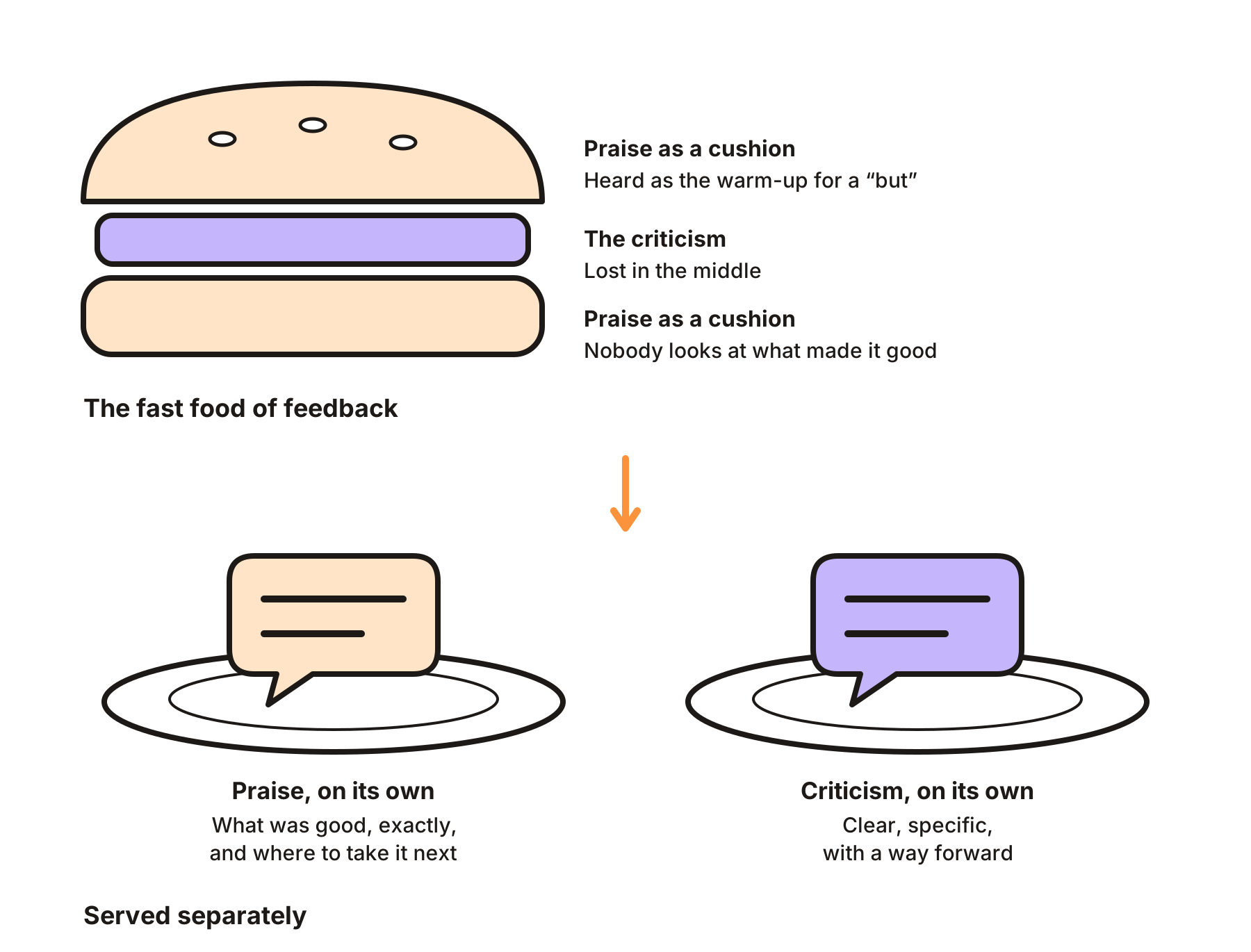
The feedback sandwich goes like this: something good, then the thing that needs to change, then something good again. We use it because it feels kind. The good parts soften the bad one, and we leave the conversation thinking we handled it well.
The problem is that the sandwich does neither job. Praise used as a cushion is easy to spot, and people figure it out fast. After a while, every compliment sounds like the warm-up for a “but,” and they stop hearing it. The criticism, meanwhile, gets squeezed between two nice things, and the person walks out remembering the bread. Adam Grant, the organizational psychologist, made this point in his article “Stop Serving the Feedback Sandwich”: people tend to remember what comes first and last in a conversation, so whatever sits in the middle is the easiest part to forget.
Most of what gets said about the sandwich is about the bad part getting lost. The good part loses even more, and it gets far less attention. Feedback is also about what someone did well, so they can do more of it and take it further. In the sandwich, the good thing is only there to cushion the blow. Nobody looks at what made it good, and the person doesn’t grow from it. So the sandwich makes the good part worse and still doesn’t fix the bad one.
The fix is to take apart what the sandwich puts together. When someone did something well, say it on its own. Say exactly what was good about it, and where they could take it next. When something needs to change, say that on its own too, clearly, with a way forward. Both are feedback, and each one deserves its own moment.
Preparing your feedback, step one: when to give it
Every good dish starts with fresh ingredients, and in feedback, freshness is a matter of timing. We tend to treat feedback as an event. It needs a meeting on the calendar, a quiet room, some preparation, maybe a form. So it waits, and a lot of it ends up in the year-end review, months after anyone can do much with it.
Any moment can be a moment for feedback, whether it’s positive or negative, big or small. It can happen in the two minutes after a meeting, while both of you still remember what was said. The one-on-one that’s already on the calendar works too. And the year-end review is also a moment for it, as long as it isn’t the first time the person is hearing it.
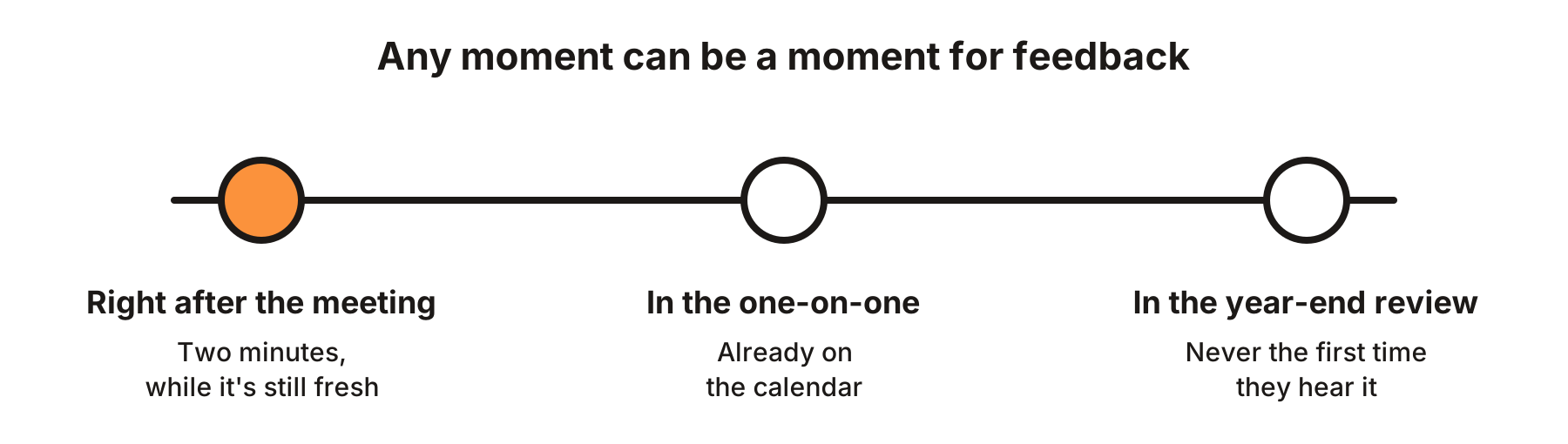
What changes is the size of the ceremony. Feedback given close to the moment needs very little setup. “Can I give you a quick thought about the call?” is enough to open it. The closer it is to what happened, the more specific it can be, and the less it sounds like a verdict. Kim Scott, whose method comes next, lists “immediate” among the marks of good feedback and suggests looking for chances to give it on the spot, in the gaps of the day.
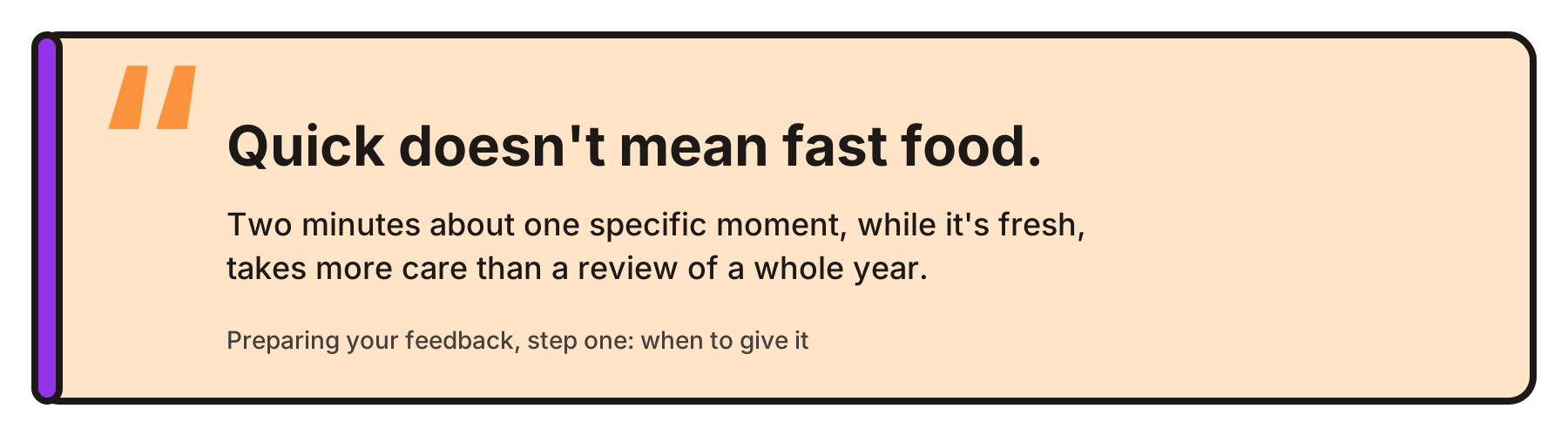
Quick doesn’t mean fast food, though. Two minutes about one specific moment, while it’s still fresh, takes more care than a long review that tries to cover a whole year.
Once feedback is a normal part of the week, nobody has to brace for it. That’s how it stops being a big deal for both sides.
Step two, the recipe: Radical Candor
For the recipe itself, there are plenty of structured methods, and we covered three of them in our post on constructive feedback. If the question is how to give feedback that’s honest without being harsh, this is the one we recommend: Radical Candor, from Kim Scott, who led teams at Google and Apple and wrote the book Radical Candor.
Radical Candor rests on two dimensions. The first is caring personally: showing the person you care about them, and not only about the work. The second is challenging directly: telling them what they need to hear, clearly. Cross the two and you get four quadrants, four ways a piece of feedback can go.
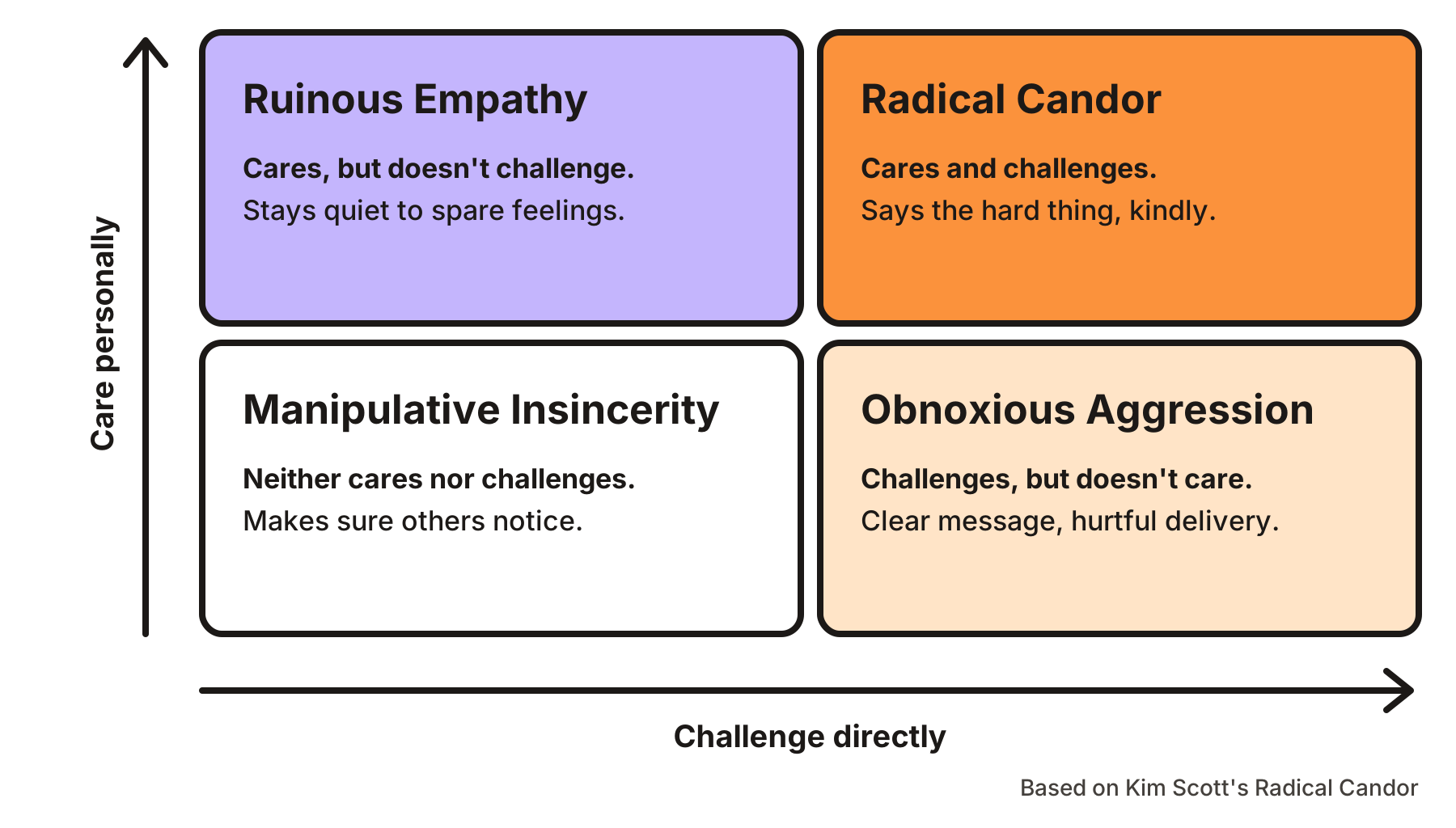
Radical Candor. You care and you challenge. You say the hard thing, and the way you say it shows it comes from wanting the person to do well. This is the quadrant Kim Scott recommends.
How we see it: it’s the obvious choice when you read the four, and the hardest one to actually do. We worry the person won’t take it well, or that what we have to say will upset them. That’s the barrier. Even so, it’s the right way to do it.
Ruinous Empathy. You care, but you don’t challenge. You stay quiet, or soften the message until there’s nothing left of it, to spare the person’s feelings. It feels kind in the moment and costs the person later. Scott says this is where most of us make most of our mistakes, and it’s where the feedback sandwich usually lives.
How we see it: this is probably the one you see most often in companies. People believe they’re doing the other person a favor. Better not to bring up something unpleasant, the thinking goes, because the person will be upset. What we see is the opposite: it holds the person back, and the company along with them.
Obnoxious Aggression. You challenge, but you don’t care. The message is clear and the delivery hurts. The person gets defensive, and the point gets lost while they defend themselves.
How we see it: this is usually the feedback of someone who reads the room poorly and doesn’t see the impact of what they say. You know the line “I just tell the truth, no matter who it hurts”? It’s true up to a point. You can tell the truth and still read the room first, choosing the moment and the way to say it so it lands. That reading is what’s missing here.
Manipulative Insincerity. You neither care nor challenge. You don’t tell the person, but you make sure other people notice: a remark behind their back, a hint in the group chat. Scott calls it the worst of the four.
How we see it: we agree with her. When feedback comes from this quadrant, it’s worth looking at on its own, because it says a lot. It’s more than a skill that’s missing. It’s a behavior that doesn’t belong on a team.
One thing before the example. The quadrants describe what we say, not who we are. Any of us can land in any of them on a given day.
When it fits
Whenever you notice something the person can’t see for themselves and would want to know. It works for praise as well as criticism. Scott’s rule for the setting is simple: criticism in private, praise in public.
A situation
A new analyst joins the quarterly planning meeting with the director. She brings three ideas, and they’re good ones. The one about pricing gets the director writing in her notebook. All three start the same way: “This is probably a dumb idea, but…” By the third, people have started tuning out before she gets to the idea.
Four colleagues were in the room, and each one did something different with what he noticed.
The first one said nothing. She’s new, he thought, and pointing it out would only make her more nervous. Three months later, in her first review, the word “confidence” comes up, and it’s the first time she hears it.
The second one also said nothing to her. After the meeting he told two people at the coffee machine, “Did you notice she calls her own ideas dumb?” and let the label do the rest.
The third one said it right there, in front of the director: “Stop saying your ideas are dumb. If you think so, why bring them?” She didn’t speak again for the rest of the meeting.
The fourth waited for the meeting to end and caught her on the way out. “Can I tell you something about today? Your pricing idea was the best thing said in that room. You opened it, and the other two, with ‘this is probably a dumb idea.’ People hear the opening before they hear the idea. Next time, just start with the idea.” She tried it the following week.
Where each quadrant shows up
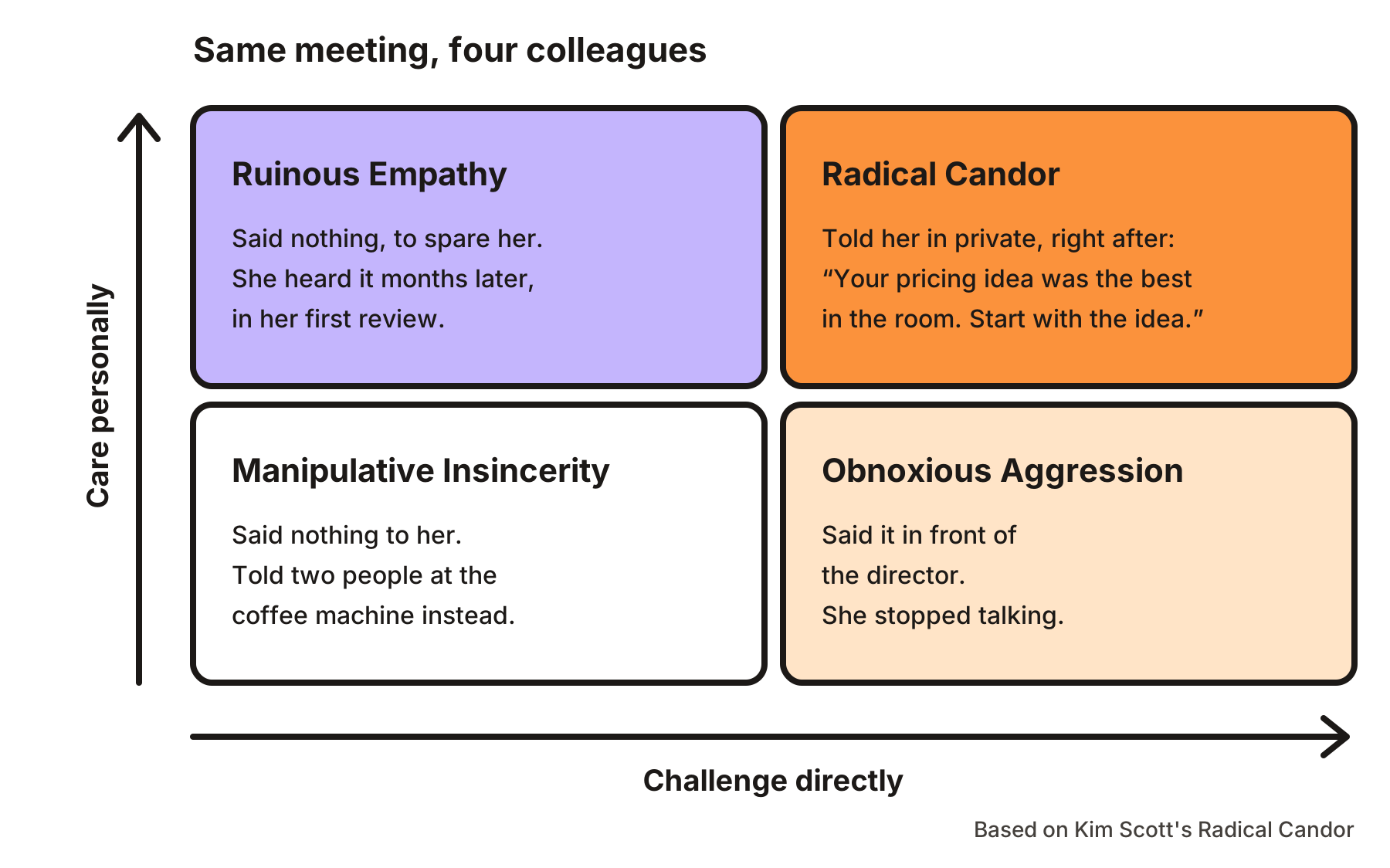
- Ruinous Empathy
- The first colleague cared about her, and that’s exactly why he kept quiet. The habit didn’t go away. It reached her later, from someone else, when there was less she could do about it.
- Manipulative Insincerity
- The second one didn’t care and didn’t challenge, and the habit turned into a story about her, told without her.
- Obnoxious Aggression
- The third one challenged her directly, in public, and the point drowned in the embarrassment.
- Radical Candor
- The fourth told her in private, right after the meeting. He was specific about what was good, named the one behavior that was hurting her and gave her something to try instead. He cared, and he challenged.
Phrases you can use to stay in Radical Candor
Can I tell you something about the meeting? It’ll take a minute.
I’m telling you because I think you’d want to know: behavior.
That part was really good, specifically what. It’s worth doing again.
Next time, try action instead.
How to prepare your feedback with Skill Deck
There’s another reason we end up in Ruinous Empathy, besides wanting to spare the other person: we’re not sure. Did it really happen that often? Am I remembering it right? It’s like trying to cook without the ingredients on the counter. Without something concrete to point to, staying quiet feels safer than challenging, and the same doubt pushes feedback to later, while we wait to have more to go on.
Skill Deck does the mise en place. It works from the meetings your team already has, and after each meeting every person gets an analysis in their inbox, with the moments where a people skill showed up and what each one changed for the room. The ingredients arrive fresh, right after the meeting, so the moment no longer has to be created. And the person gets them first, in private, which is where Scott says criticism belongs.
For the leader, the conversation starts with everything already on the counter. Instead of “I feel like you’ve been doing this,” you walk in with the specific meetings and the specific moments, and challenging directly gets easier when what you’re pointing at is right there. The cooking is still yours: caring personally, and choosing how to open the conversation. Our recommendation is about fifteen minutes a month per person, which is enough to keep feedback on the agenda all year instead of saving it for the review.
You still have the conversation, which is the part only you can do. Skill Deck brings the ingredients.
Give one piece of feedback this week
Think of one thing you noticed in a meeting this week and haven’t said. Then ask yourself which quadrant your silence is in. If you held it back to be kind, that’s Ruinous Empathy, and the way out is a two-minute conversation in private before the week ends. Tell them what you saw and what to try next time. And if it was something good, say that too, on its own.
If you want the moments ready before you walk in, Skill Deck finds them in the meetings your team already has.
skilldeck.ai