Everyone knows what feedback is, and everyone has received some. Most of it is a comment on something that happened. “Good job, congratulations, that was great.” “That meeting ran long, but you did well.” Sometimes it’s the other way: “That wasn’t good. You were late to the meeting, and I hope it doesn’t happen again.”
That kind of feedback is fine and matters, but it can also go further. The approach we take at Skill Deck is constructive feedback, the kind where the person leaves the conversation with a way to do better next time.
What constructive feedback is
Douglas Stone and Sheila Heen, in Thanks for the Feedback, call this type of feedback coaching: the kind that says “here’s how to get better,” as opposed to the kind that only recognizes or only evaluates.
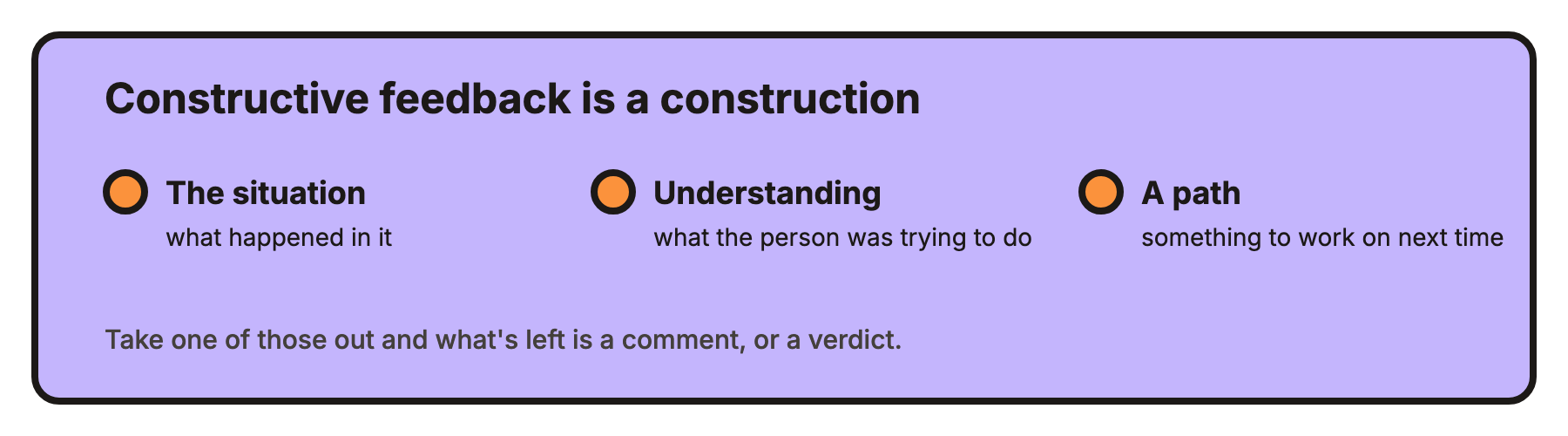
What makes constructive feedback hard is that it’s itself a construction. It’s very hard to bring only the constructive part. You have to talk about the situation and what happened in it. You have to show the person you understood what they were trying to do. And you have to have a path, something they can work on so they get better next time. Take one of those out and what’s left is a comment, or a verdict.
Why constructive feedback gets left for later
We all know feedback matters. We also skip it constantly, and the reason is rarely bad intent.
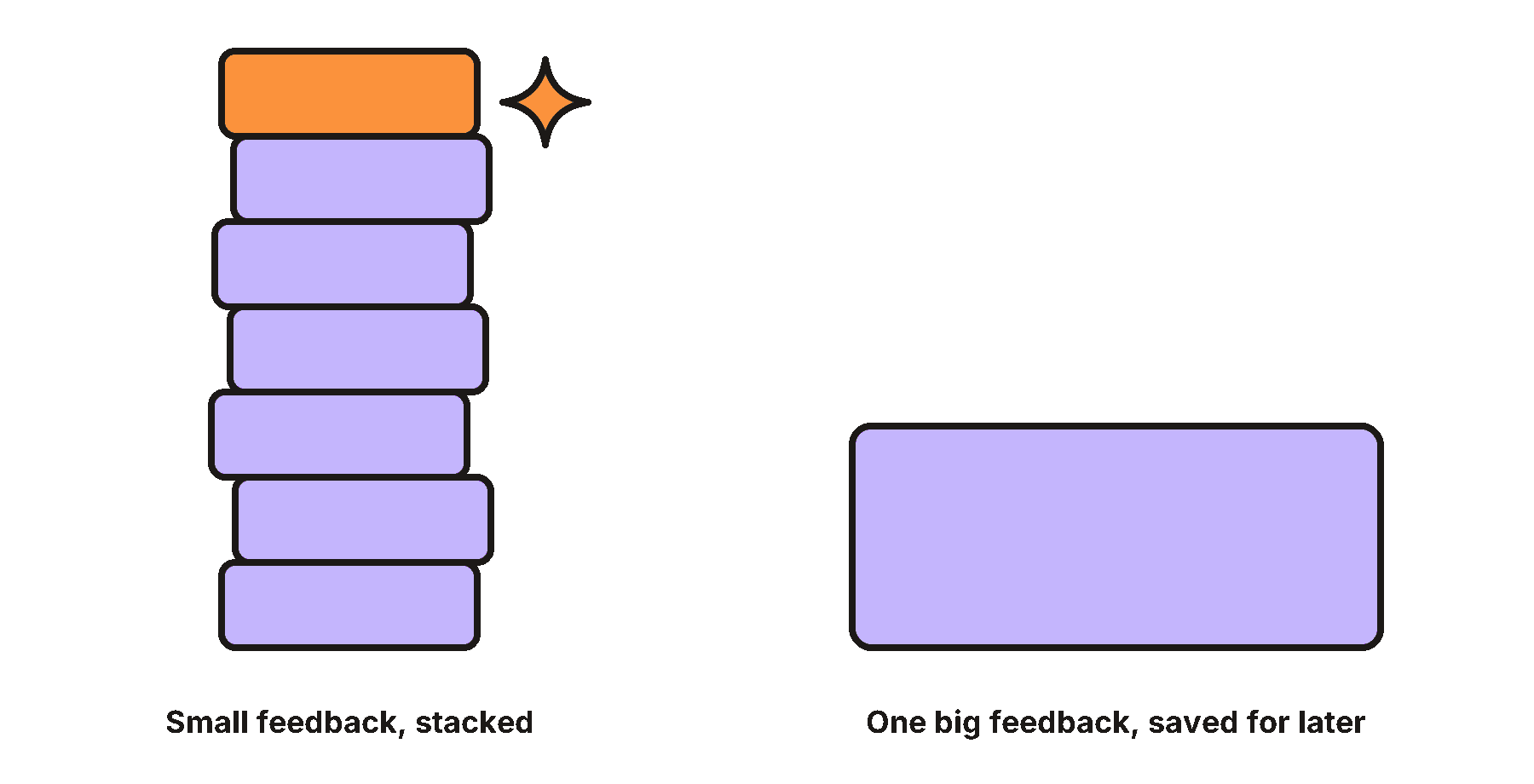
The feedback that develops people is mostly small. Something a person did in Tuesday’s client call. The way they handled a question in the sprint review. Each one is a few minutes of conversation, and each one feels less urgent than whatever is next on the calendar. So we save it for a bigger conversation, the one-on-one, the quarterly review, and by then the moment is gone.
That’s a loss, because the way people grow is by stacking one feedback on top of another. One small feedback improves one small thing. The next one improves another. Look back after a few months and the person has moved a long way. When we leave everything for one big feedback, the shift we’re asking for is too big, and it rarely happens.
Structure is what makes the small moment affordable. Without a tool, feedback is an opinion you have to work up to. With a tool, feedback stops being a comment on a situation and becomes direction: a way for the person on the receiving end to be better the next time that situation comes around.
That’s why we bring here three methods for constructive feedback that we like at Skill Deck, and recommend you use in different situations of your work. Each one stands on its own. You can combine them, but you don’t have to.
4A: an agreement between who gives and who receives
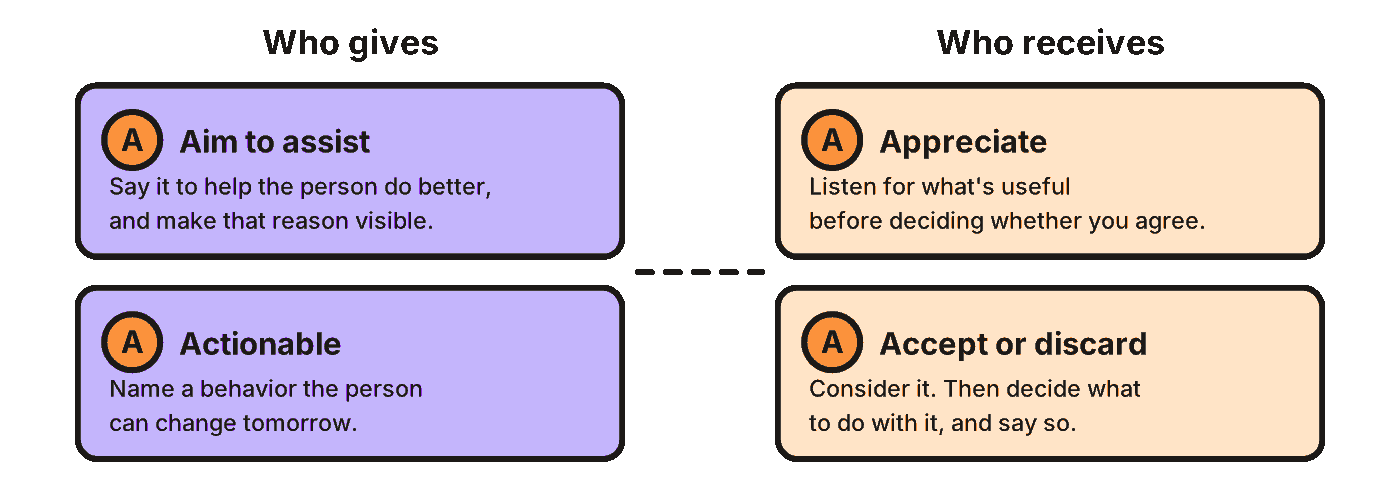
We start with the 4As because, besides being constructive on their own, they have something few methods have: an agreement between everyone, the person giving the feedback and the person receiving it. If feedback is going to be constructive, the person receiving it has to be open to it. The 4A guideline comes from Netflix, published by Reed Hastings and Erin Meyer in No Rules Rules.
Two As are for whoever gives the feedback.
- Aim to assist
- Say it because you want the person to do better, and make that reason visible. Feedback given to get something off your chest, or to be right, isn’t this.
- Actionable
- Say something the person can change. A verdict about the person isn’t actionable. A specific behavior they can work on tomorrow is.
Two As are for whoever receives it.
- Appreciate
- The natural reaction to feedback is to defend yourself. Listen for what’s useful first, and thank the person before you decide whether you agree.
- Accept or discard
- You’re obliged to consider the feedback. You’re free to decide what to do with it, and you can say so.
When it fits
When a team agrees on it out loud, before any other method. Once people know that whoever gives feedback is trying to help, and whoever receives it gets to decide what to keep, the small moments get much easier to open.
A situation
In the weekly planning meeting, a product manager cuts a developer off twice while he’s explaining why an estimate grew. After the meeting, a colleague stops by: “Can I give you some feedback? I’m saying it because I think you’ll want the team talking more in planning, not less. Twice today you jumped in while Marcos was still explaining the estimate, and he dropped the second half. You asked the right question both times. If you hold it until he finishes, you’ll get the answer and the rest of what he had.” The product manager says thanks, asks whether it happened in other meetings too, and says he’ll try holding the question until the person finishes, but won’t stop asking it, because the estimate matters.
Where each A shows up
- Aim to assist
- The colleague said why she’s giving the feedback, and it’s about the team working better, not about being right.
- Actionable
- One behavior, two moments in one meeting, and a specific thing to do instead.
- Appreciate
- The product manager thanked her and asked a question instead of explaining himself.
- Accept or discard
- He took the part about holding the question and said, out loud, what he’s keeping.
Both sides did their part.
Phrases you can use
When you’re giving it
Can I give you some feedback? I’m saying it because reason.
One specific thing: behavior. What you could do instead is action.
When you’re receiving it
Thanks. Let me think about which part of that I can use.
I hear it. I’ll try the first one and leave the second for now.
COIN: for one specific thing you saw
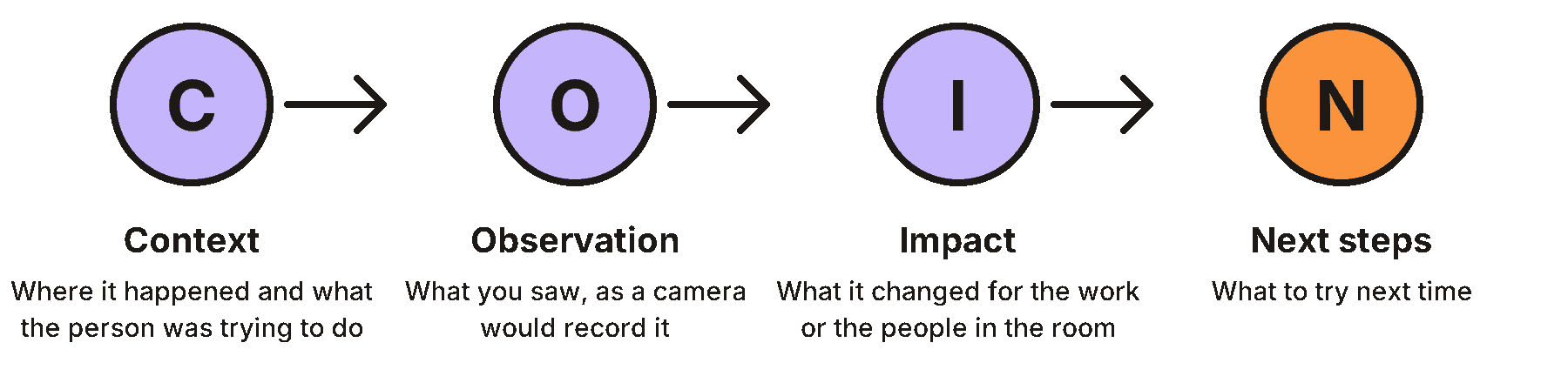
COIN comes from Anna Carroll’s The Feedback Imperative. It stands for Context, Observation, Impact, Next steps, and it’s the method for the moment right after something happened.
- Context
- Where and when it happened, and what the person was trying to do.
- Observation
- What you saw, as a camera would record it. If your sentence has “always”, “never” or an adjective about the person in it, it’s a judgment, not an observation.
- Impact
- What it changed, for the work or for the people in the room.
- Next steps
- What to try next time.
From the description alone, you can see why it’s constructive feedback, mainly because of the impact and the next steps. So let’s see how it plays out in reality.
When it fits
After a meeting you were in, about one specific thing the person did, good or bad. It takes under a minute to say, which is why it works for the small moments that usually go missing.
A situation
Someone presents a product on a call with two people. One is directly interested in what’s being shown. The other is mostly following the conversation. At the end, the one who was following says: “I’d like to give you some feedback.” They set up another call.
On that call, she points out what worked and what didn’t, and then gets specific about one thing: after making a point, if the other person didn’t have an immediate question, the presenter filled the silence and kept talking. When someone is still processing what they just heard and you talk over it, they connect less with the product, and they don’t get to ask everything they want to, because they’re still working it out. The interest drops on both sides. Her suggestion: get comfortable with silence. Make the point, pause, and let the person answer. Don’t pull the answer out of them.
Where each step shows up
- Context
- She was in the meeting, so she knew who the presentation was for, who was in the room and what the presenter was trying to get out of it.
- Observation
- The presenter talked over the silence after each point.
- Impact
- The person listening connected less and asked less, because they were still processing.
- Next steps
- Make the point, pause, let the person answer.
That was excellent constructive feedback, and it followed COIN without anyone naming it.
Phrases you can use
About this morning’s meeting. Can I give you one thing I noticed?
In the call with client, I saw you observation. What I noticed afterwards was impact.
One thing to try next time: next step. What do you think?
GROW: for turning feedback into a plan
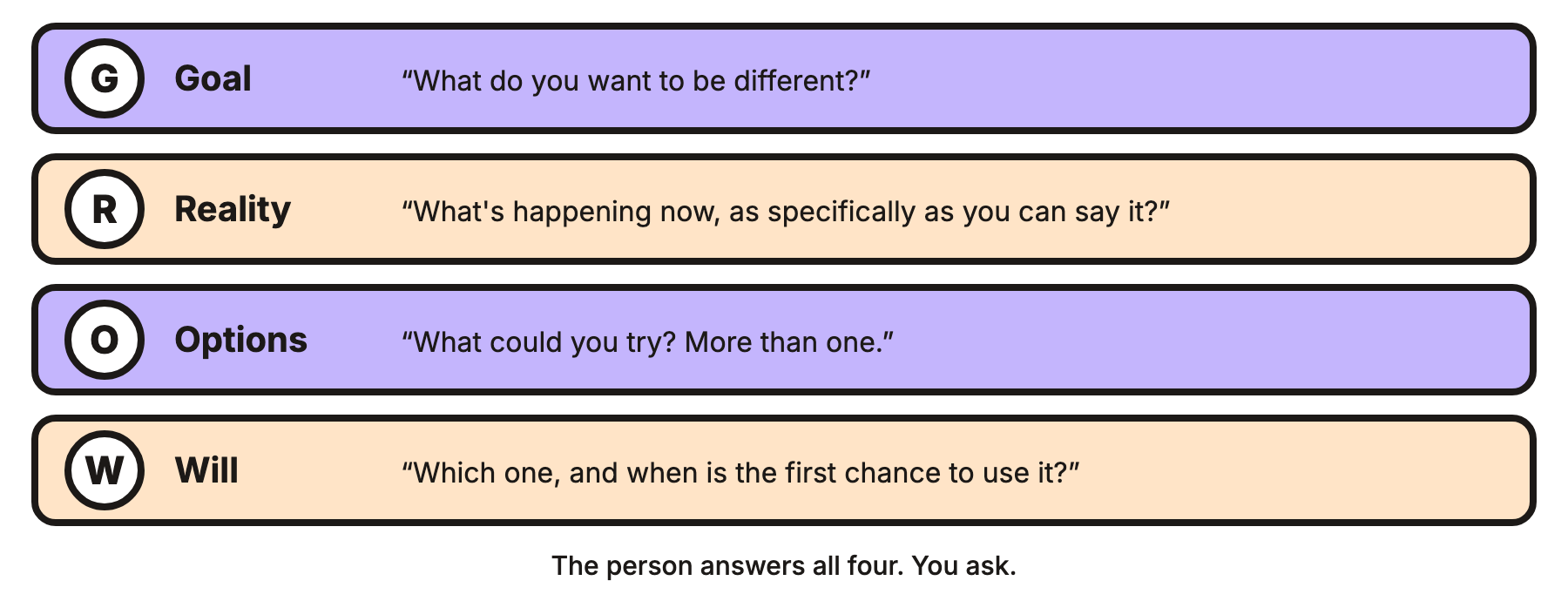
Once the person has heard the feedback, the question is what they’ll do with it. GROW is a structure for that conversation, and in it the person does most of the talking. It was created by Graham Alexander, Alan Fine and Sir John Whitmore. Whitmore later wrote Coaching for Performance, the book that made it widely known. Google teaches it in its manager training, which is why some people assume it started there.
- Goal
- What does the person want to be different? Not a vague “get better at this,” but something you’d both recognize when it happened.
- Reality
- What’s happening now, as specifically as they can say it. This is where most of the understanding gets built.
- Options
- What could they try? Ask for more than one, and hold your own suggestions until they’ve run out. Three options from the person are worth more than one from you.
- Will
- Which option, and when is the first chance to use it?
When it fits
In the one-on-one you already have on the calendar, when the feedback is on the table and the person needs to decide what to do with it. Whatever they choose, they chose it, which is the difference between a plan that happens and a plan that gets filed. It works just as well on a Skill someone is already good at and wants to take further.
A situation
A team lead reviews everything before it leaves her team. Proposals, client emails, the slides for the monthly review. The team has told her, and she’s heard it, that work waits on her desk for days. In the one-on-one, her manager asks what she wants to be different. “I want work to leave the team without going through me, and still be good.” What’s happening now? “Everything comes to me because I’m the one who knows the clients. And when someone sends something without me, I end up redoing it, so they stop trying.” What could she try? She lists three: write down which deliverables really need her and let the rest go out; review the outline instead of the final version; pair with one person on the next proposal so they see how she thinks. Which one? “The list. I’ll share it Monday, and anything not on it goes out without me.”
Where each step shows up
- Goal
- Work leaving the team without her, something both of them will see within weeks.
- Reality
- Said by her, including the part where redoing the work teaches the team to wait.
- Options
- Three, all hers; the manager held back.
- Will
- One option and a date.
The manager asked four questions and didn’t propose anything, and the plan is hers.
Phrases you can use
What would you like to be different the next time this comes up?
What’s actually happening now, as specifically as you can say it?
What are three things you could try? There’s no wrong one.
Which one, and when’s the first chance to use it?
Constructive feedback with Skill Deck
Constructive feedback has two parts. One is the method, and the three above cover it. The other is the material: the context of the meeting, an observation precise enough to be filmed, what it changed for the people in the room, a reality the person can state without guessing, options beyond the ones the manager happened to think of. The method you learn once. The material has to be collected every time, which means the leader was in the meeting, noticed the moment, and remembered it well enough to describe it a day later. When the material isn’t there, the feedback stays a comment.
Skill Deck is a tool for the material. It works from the meetings your team already has. For each person, it finds the moments where a people skill showed up, and breaks the meeting down moment by moment: what the person was trying to do, what they did, what it changed for the room, and what the next level of that skill would have asked for in the same situation.
Our recommendation is the one from the start of this post: bring these feedbacks back onto the agenda. They’re the small moments, and Skill Deck maps them for you. With about fifteen minutes a month per person, you can put feedback back on the agenda and make it constructive feedback. And if you liked the three methods above, they all work with it.
- COIN
- Skill Deck brings the context, the observation and the impact, already written down before you walk in. What’s left for the leader is the part the tool can’t do: choose which of those moments is worth a conversation this week, and agree with the person on the next step, in their own work and their own words.
- GROW
- Skill Deck brings the reality, the step where most of the understanding gets built and the one most often answered from memory. Instead of “I think I’ve been doing this a lot lately,” the person sees the meetings where it happened, what they did in each one and what it changed. With the reality on the table, the conversation can spend its time on what only the person can answer: the goal, the options and which one they’ll start with.
- 4A
- The 4As are protected by the order things happen in. The person receives the analysis first, in their inbox. They see it, appreciate it or not, and decide what to work on, before anyone else brings it up. When the leader does, the feedback is about a specific behavior in a specific meeting, which is what makes it actionable.
You still have the conversation, which is the part only you can do. Skill Deck brings the elements to it.
Put constructive feedback on the agenda this week
- Pick one person on your team and one thing they did in a meeting this week. Not the biggest thing, just one specific thing, good or bad.
- Give it to them in under a minute, before the next meeting starts, with whichever of the three methods fits. That’s constructive feedback.
- Do it again next week, on another small thing, and let them stack.
If you want the evidence ready before you walk in, Skill Deck finds it in the meetings your team already has, shows where each person stands on each of 58 Skills, and points to the Practice to work on next.
skilldeck.ai